Interdisciplinary Perspectives on Separation
Lund University, 28–29 October 2024 · By Marit de Wit · Back to Events · Programme
This October scholars from a wide variety of backgrounds travelled to Lund University in Sweden to take part in the workshop ‘Interdisciplinary perspectives on separation’, organised by the team of the research project ‘Moved Apart: Communicated Experiences of Separation in the Sixteenth and Seventeenth Centuries’. The aim of the workshop was to discuss the concept of ‘separation’ and how this is applied in different fields. Over these two days, thought-provoking presentations and discussions opened our eyes to the relevance and possibilities of the concept of separation.
Lisa Hellman, PI of Moved Apart, introduced the project. She explained how the research project offers a different lens on early globalisation by turning the connection bias on its head. By focussing on how globalisation moved people apart, instead of bringing them together, the project opens new avenues of enquiry. It aims to balance gender bias and is equally interested in those who left as those who are left behind. The project team faces important theoretical and methodological questions regarding the analysis of emotions in a global historical context. Lisa Hellman noted that in Confucianism there is such an emotion as ‘thought’ and invited the speakers to feel thought with us during this workshop to bridge the separation between different scholarly fields.

The sessions were chaired by the project team’s researchers Polina Barducci, Susan Broomhall, James Daybell and Svante Norrhem, and supported by research assistants Cecilia Lundström and Marit de Wit. The presentations and discussions ranged from exile practices in seventeenth-century Korea to Finnish arctic hysteria, and from ancient Indian philosophy on longing, to loneliness among adolescents in the United Kingdom. Some important discussions that came up were the universal or the culturally defined feelings of separation, the individual and the communal aspect of emotions, and sources and methodologies for accessing experiences of marginalised groups.
Thank you from the Moved Apart team to all the speakers and participants, and a special thank you to the attending advisory board members Claudia Jarzebowski, Kapil Raj, and Antje Richter.

The sessions
Session 1
The opening session was chaired by James Daybell, Professor of Early Modern British History at the University of Plymouth, and coordinator of the Work Package ‘Letters’ at the Moved Apart project. The presenters came from different fields of expertise, and all discussed ‘separation’ in their case studies.
Jae-Eun Noh is Research Fellow at the Gender and Women’s History Research Centre at Australian Catholic University and presented on ‘Solidaristic emotions of ‘comfort women’ survivors and activists’. She used Bourdieu’s concept of ‘habitus clivé’: a life-changing experience of losing ‘a sense of self torn by contradiction and internal division’, as comfort women were forcibly disconnected from their countries and mother tongue. She discussed how emotions enabled recognition and solidaristic practices for comfort women.
Jisoo M. Kim, Korea Foundation Associate Professor of History, International Affairs, and East Asian Languages and Literatures at George Washington University, presented on ‘Separation through Exile: Marriage, Concubinage, and Sexual Intimacy in Sixteenth-Century Korea’. To get to experiences of separation, Kim used the diary written by Miam Yu Hūich’un, as well as poetry by his wife Madam Song Chong-gae. With her talk Jisoo M. Kim showed that exile is culturally dependent. Exile made for a profound feeling of loss and loneliness – especially in a society like Korea where the family is central to identity and social role.
Andrew Gordon, Professor of Renaissance Literature and Culture at the University of Aberdeen presented on ‘Separation in the Letter of Philip Sidney, and the Alleyns’. In his talk Gordon notes the ‘phatic’ function in letters, which refers to the space in letters dedicated to discussing the letter itself. He underlines the multiple agents at work in letters, not merely the writers, but also the role of the letter bearer – with which he encourages us to look at epistolary paratext. Different letter writing strategies were used to deal with separation.
Discussion
- Three stages of solidarity. Jae-Eun Noh presented three stages—standing up for, standing up with, and standing up as. A key question raised was what happens at the final stage of solidarity. Noh described how emotions evolve from pity, to empathy, and finally to deeper identification with victim-survivors.
- Unspoken emotions. The discussion turned to how emotions are sometimes not spoken, especially during separation. The question was raised about how we access and understand these unspoken emotions, especially for women.
- Culturally shaped emotions. Emotions are culturally situated and shaped by conventions, leading to discussions on how emotional expression varies across contexts.
- Trauma beyond words. The issue of trauma was discussed, with a focus on how to understand and express trauma beyond what can be articulated in words.
Session 2
The second and last session of the day was chaired by Susan Broomhall, coordinator of the Work Package ‘Life Stages’ at the Moved Apart project. Broomhall is Professor of Early Modern Studies at the Institute for Religion and Critical Inquiry and leads the Gender and Women’s History Research Centre at the Institute for Humanities and Social Sciences at Australian Catholic University.
Eric Cullhed, Professor of Ancient Greek at Uppsala University, first presented his ideas about separation through the concept of longing, ‘The Moral Psychology of Longing: Four Lessons from Indian Philosophy’. Looking at sources like the Nāṭyaśāstra, and learnings from Rupa Goswami, Cullhed distils four lessons. Striking were aspects of the body and the senses in conceptualising longing and love. For example, longing was described like a fever taking over your body. Moreover, separation is not just a physical concept, as people can feel separated from each other when they are not far apart or can feel connected to someone far away.
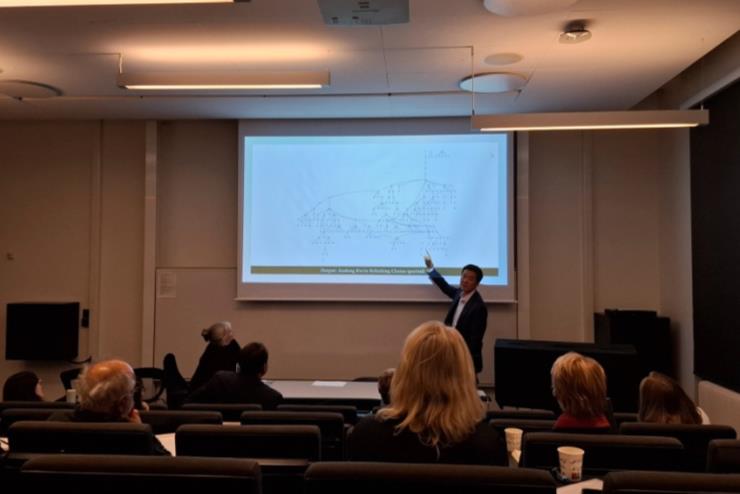
Javier Cha, digital historian and medievalist at the University of Hong Kong, approached the concept of separation through digital methods. In his presentation ‘Digital Insights into Centripetal and Centrifugal Forces in Medieval Korea’, Cha explored three lines of enquiry, showing with digital readings of sources like epitaphs and genealogy how patterns of family and power can be identified.
Yow-Jiun Wang, associate professor in the Department of Taiwanese Literature at National Cheng Kung University, showed a different methodology for researching separation, namely interviews. In her presentation ‘Constructing and sharing migrant memories on social media: A case study of Vietnamese female migrants in Taiwan’ Wang shows how migrant women construct identities through the narratives they share. Their communicated experiences are shaped by their imagined audience, and they self-censor to meet the expectations of their families.
Discussion
- Role of senses and symbols. Emotions like longing are often expressed through sensory experiences rather than just language (following Cullhed’s talk on Indian philosophy).
- Cultural scripts. In Yow-Jiun Wang’s study, women were expected to be strong and typically didn’t share negative emotions in their social media posts, adhering to a cultural script.
- Medium of expression. The way emotions are conveyed is influenced by the medium. For example, letters are emotionally charged and can be difficult to process emotionally.
- Digital methodology. Cha discussed the use of digital methods, such as semantic networks, to analyse categories like gender and age, and how other sources and networks could be explored.
- Positives of separation. Lisa Hellman raised the question of whether separation is inherently negative or if there could be positive aspects to it.
Session 3
The following day the first session was chaired by Svante Norrhem, coordinator of the Work Package ‘Time and Space’ in the Moved Apart project. Norrhem is Associate Professor of History at Lund University. The first presentation was by the Dean of Divinity and Chaplain of New College Oxford, Erica Longfellow. In her paper ‘Love, faith and affliction: practical divinity and consolation for English Protestants separated from loved ones’, she considers the sources from which early modern English Protestants found religious consolation when they were separated from loved ones. Striking in a review of this material was the absence of religious text meant for consoling the people left behind. Longfellow notes that we cannot understand early modern emotions, without understanding the communal experience – people would rarely be left all alone because of the communal nature of the early modern period.
While Wally Cirafesi, connected to the Centre for Theology and Religious Studies at Lund University, was unfortunately unable to attend, his presentation concerned ‘Diaspora as Cultural “Separation” in Ancient Judaism’. Based on Daniel Boyarin’s conceptualisation, Cirafesi approached diaspora as a kind of cultural separation that illustrates the ways that ancient Jews negotiated their varied relationships and attitudes toward the concept of homeland.
Professor of Finnish literature at the University of Helsinki Riikka Rossi presented her paper ‘The Finnish Arctic Hysteria’. In this case study Rossi approaches the concept of arctic hysteria through the history of emotions. She is influenced by Margaret Wetherell, who theorised that emotional reactions largely rely on ritualised expression and patterns, although they have a biological basis. Following Sara Ahmed, Rossi sees emotions as being shaped by the interaction between the individual and society. William Reddy theorised that cultural norms shape how emotions are expressed, providing language frameworks that become ingrained over time and passed down through generations within ‘emotional communities’, as conceptualised by Barbara Rosenwein. With this framework Rossi explains how arctic hysteria, although scientifically disproven, has remained alive in Finnish culture and literature.
Discussion
- Separation as poignant. Separation is emotionally significant because people didn’t know if they would be reunited. The absence of letters during separation contributes to the poignancy, as it leaves uncertainty about the future.
- Epistolary models and emotional expression. Erica Longfellow suggests looking at letter-writing to understand how separation was discussed. Separation could also be underrepresented in these letters however, as people may avoid highlighting the painful aspects of it.
- Gender and emotional expression. There’s mention of gendered hysteria but also an acknowledgment that emotional expression was not always gender-specific, challenging assumptions about gender and emotional norms.
- Transgression and emotional control. Controlling emotions was seen as necessary to avoid transgression, highlighting a cultural expectation of emotional restraint.
- Non-human agency. There’s mention of non-human factors as influencing emotional experiences, suggesting an interplay between environment and emotional expression.
- Geographical specificities. The group touches on the different ways emotions are perceived and expressed in various cultures, as for example is the case with ‘arctic hysteria’.
Session 4
The second session of the day was chaired by Polina Barducci, Postdoc of the Moved Apart project, focussing on Japanese letters. Two of the speakers were PhD researchers at the Division of Psychiatry at University College London, focussing on loneliness.
Sharon Eager presented her research project ‘Examining the development, experience, and mental health outcomes of chronic loneliness in adolescents’. She defined loneliness according to her field as: ‘a subjective feeling of being apart from others; feeling that social relationships are lacking in quality or quantity’. Transient, or occasional, loneliness differs from chronic loneliness, which can have a different impact on mental health.
Theodora Stefanidou presented on ‘Impact of loneliness on psychological treatment outcomes for adults with depression and anxiety disorders’. In her research she found that life transitions can lead to feelings of loneliness among clients. Also, people can still feel lonely despite taking part in regular social interactions and experience ‘emotional loneliness’.
The topic of isolation was picked up by Lena Halldenius, Professor of Human Rights Studies at Lund University in her talk ‘Mary Wollstonecraft and the philosophical importance of travelling’. In her travelogue Wollstonecraft noted that only the solitary mind could have clear impressions, and that being by yourself could free the mind. She used the form of the letter as a philosophical tool, writing to a lover.
Discussion
- Modern communication. It was discussed why phones or online interactions don’t seem to alleviate loneliness. This communication doesn’t seem to provide the same sense of true belonging. The quality of social connections is more important than mere physical presence, and different types of media can either worsen or help loneliness depending on the person and context.
- Age and loneliness. There was a debate on whether people get better at handling loneliness as they grow older. It was suggested that the source of loneliness could change with age – young people may experience loneliness due to smaller, more constrained social circles, while older adults may experience it due to isolation or societal detachment.
- Positive aspects of solitude. The potential positive side of solitude was also explored, with some suggesting that solitude can be a creative or reflective practice, rather than simply an experience of isolation. In particular, historical figures like Wollstonecraft were mentioned as examples of how solitude can be both oppressive and liberating, depending on the context.
- Historical perspectives on loneliness. The conversation also touched on how loneliness has been experienced and conceptualised historically. For example, the role of colonialism, class, and global contexts in shaping experiences of isolation were considered, particularly in relation to historical figures like Wollstonecraft.
- Loneliness and gendered expectations. It was noted that women historically have paid a higher social price for stepping outside societal norms, making loneliness particularly destructive for them when they deviate from the expected role. In modern studies however, it is clear that men feel more restricted in sharing their experiences with loneliness.
Session 5
The last session started with Miles Ogborn, Historical Geographer at Queen Mary University of London. In his talk ‘Bearing Risk: Global Trade, Paperwork and the Management of Separation’ Ogborn discussed the new form of communication in the late seventeenth century: the global letter. He focuses on how letters of the English East India Company sent between Madras and London managed issues of trust, risk, and emotional distance, while also considering the materiality of the letters and the collective processes of writing and reading.
Gunvor Simonsen, Associate Professor at the SAXO-Institute of the University of Copenhagen, presented ‘In the Same Sea: Free Soil and the Geopolitics of Antillean Slavery’. Simonsen noted how Caribbean history is one long history of separation and illustrated this by a discussion on the concept of free soil, and enslaved fugitives.
Nicholas Loubere works as an area specialist at the Centre for East and South-East Asian Studies at Lund University. In ‘There and Back Again: Identity, Nostalgia, and Trauma in Chinese Gold Rushes’ Loubere discusses separation in the context of Chinese labour migration, and especially identity construction after people return home. He thereby relates processes of globalisation to individual and community responses to separation.
Discussion
- Experiences of enslaved people. Enslaved people’s experiences, especially through letters, highlight emotional themes such as grief, longing, and family connections. For example, in a letter of the enslaved woman Florentine she expressed grief about being sold away from her family and reached out to her mother for help. This shows a deep emotional connection to family as a source of comfort and hope. The importance of reuniting with family is a central theme for researching enslaved fugitives. Many enslaved people sought to return to their families or maintain contact with them, emphasising that family bonds often outweighed other challenges, such as harsh conditions in new locations like Puerto Rico.
- Global networks and colonial contexts. The concept of the ‘global letter’ is compared with other examples, like Dutch letters. These postal infrastructures reflect the global networks of colonial trade, migration, and communication during the 16th and 17th centuries. The structure of colonial offices, officials, and their correspondence reveal logistical and emotional implications of separation in the colonial world.
- Material culture. Separation could be expressed through materiality, for example through portraits, or photographs. In the case of the Chinese miners, they used pictures as objects of memory and identity.

Final discussion
Susan Broomhall led the final conversation of the workshop by asking the participants how they think about the concept of separation after the workshop.
The concept of separation
Separation is a useful concept for several disciplines, although it has not been used or thought of much. Defining a universal definition of separation is challenging, as the contours of the concept depend on the context. Separation is not merely a structural or physical condition, but has deep emotional and cultural dimensions. It therefore could be seen as a multi-faceted concept, varying per culture and historical period. This aligns with the argument of the Moved Apart project, that separation has a history.
Methodologies and sources
Historical sources such as letters, poetry, and material culture can be used to trace experiences of separation. These materials show not just the event of separation but the emotional responses to it. The attendees also considered how to address gaps in the sources, particularly the voices of marginalised groups, who might be connected to elite figures but whose experiences remain hidden. It was suggested to also look outside of the sources and be very aware of the context. The concept of separation allows for seeing the individual experiences in big structures, for example in bigger digital humanities studies. For migration studies the concept of separation can be fruitful, as it focuses on physical and emotional experiences of groups and individuals.
Theory
Attachment theory (for example John Bowlby’s work) was discussed as being vital to understanding how people experience separation. From an anthropological perspective separation can be understood from researching rites of passage, as well as death and mourning rituals. At every transformative ritual there is always an aspect of separation – separation from a deceased person, or separation from a life stage. This can also be linked to psychiatry, where research shows that life transitions can lead to feelings of loneliness. Feelings of separation are understood by the group as informed by gender and cultural context. Different cultures understand and express separation in unique ways. For example, in East Asian cultures, dreams and communication with the dead are significant elements of how separation is managed emotionally. However, there is also a notion that while the universality of emotions is contested, there is some common ground to be found in human experiences.
In conclusion, separation is a multifaceted concept that can be studied from various disciplinary perspectives, including but not limited to history, anthropology, theology, and emotional psychology. The emotional dimension of separation is critical, and exploring how people express and cope with separation through letters, rituals, and material culture can provide insights into human experiences across time and cultures. The Moved Apart team aims to do just that, with their focus on communicated experiences of separation in the early modern period in Europe and East Asia. The project’s next conference focuses specifically on early modern global separation.




With additional support from Erik Philip-Sörensens Stiftelse, Åke Wibergs Stiftelse and Stiftelsen Elisabeth Rausings Minnesfond.